
The edit
Where the art of the home becomes clear
Welcome To
Written by Megan Paterson, Principal Designer and Founder
The millwork is done. The marble is installed. The cabinetry is exactly what you drew on paper. And yet you walk in, look around, and something still isn’t resolved. We hear this more than almost anything else. And nine times out of ten, the answer is above you.
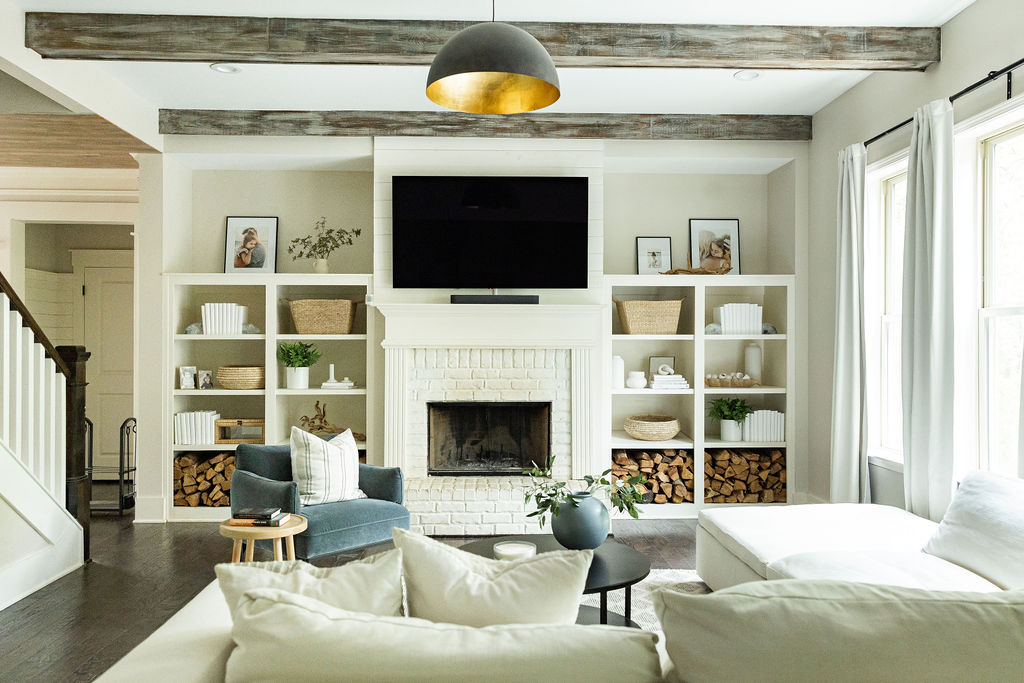
A statement light fixture does what no amount of accessorizing can replicate. It draws your eye up, sets the scale, and tells you almost immediately what kind of room this is. More than any other element in a space, lighting is always on display. Lit or unlit, morning or midnight, it is the one design decision that is never off duty.
We design homes that feel authored, not assembled, designed around you and your family’s lifestyle. That philosophy shows up everywhere, but lighting is where it tends to show up first.
What Is Statement Lighting?
Think about the rooms you remember. Now ask yourself, why? Was it the chandelier that made the dining table feel like an occasion? The lantern in the entry that told you something before anyone said a word? Maybe the sconces that turned a hallway into a room with a mood. That’s what statement lighting does. See, statement lighting is any light fixture that’s designed to be noticed. It becomes a focal point in a room, not just a source of light. It’s the detail that sets the tone for everything else.
Now, we must make an important point: statement does not mean loud. A statement lighting fixture can be quietly architectural and still own a room (think;a hand-forged iron lantern, an unlacquered brass ring, or a plaster globe) As R & Company’s Evan Snyderman said of glass artist Jeff Zimmerman’s work in Elle Decor, the best lighting is, “meant to feel less designed and more naturally occurring.” That’s the standard worth holding every statement light fixture to.
And as House Beautiful noted, statement lighting can be, “the jumping-off point for a room’s decor, rather than just a finishing touch.” That’s how we think about it too.
Where Does Statement Lighting Works Best?
There isn’t one room that can’t support a strong statement light fixture, but there are a few where statement lighting does its best work, where it stops being a detail and becomes the decision.
Your Dining Room
Your dining room is the most natural home for a statement piece above your table. Ceiling height determines everything before style even enters the conversation. In a standard eight or nine foot ceiling, the fixture hangs roughly thirty to thirty-six inches above the table. In a room with twelve foot ceilings or a coffered detail above, you have room to go bigger, go longer, and let the fixture breathe in a way that a lower ceiling simply won’t allow. The right fixture overhead can make every gathering or meal around your dining table feel a little more intentional.
Your Entry
Your entry is almost always underlit, treated as a corridor rather than a room. It’s also the first thing a guest sees when they enter. The visual impact relative to cost is difficult to match anywhere else in your house and makes this often undervalued space much more inviting.
Your Living Room
Statement lighting for living room spaces works best when it anchors a specific moment, like a conversation area or a reading corner, rather than trying to light everything at once. Wall sconces at eye level keep the perimeter of the room warm and grounded while the statement lighting does the visual work overhead. It also gives every other piece of furniture something to organize around.
Your Primary Bedroom
Your primary bedroom is the most overlooked room for statement lighting. A single sculptural fixture centered overhead paired with sconces on either side of your bed removes visual clutter, frames the architecture, and gives every surface in the room something to answer to.
Your Kitchen
In your kitchen, pendant lighting over an island or peninsula is where the statement moment tends to live. And like your dining room, ceiling height matters here. A lower ceiling calls for a flush or semi-flush pendant with a shorter drop. A kitchen with generous height can carry a longer chain and a more substantial fixture without it feeling like it’s sitting on top of you. The rule is to pair it with concealed task lighting underneath so the pendants carry the visual weight without carrying the functional load. This is your kitchen after all! As the most-used room in your house, it’s important to quietly signal that you actually thought about it.
How Should You Choose the Right Statement Light Fixture for Your Style?
Choosing a statement lighting fixture isn’t about matching a style label. It’s about finding a light that fits your home’s personality..
Leaning More Traditional?
Homes rooted in traditional architecture want fixtures that age alongside them. Unlacquered brass develops a warm patina over years. Forged iron goes deeper and richer with time. Hand-blown glass carries subtle irregularities that a factory finish never will. We’ve written about this same idea in the context of marble, how a surface that ages with use isn’t damaged, it’s telling the truth about time. A fixture works the same way. Wall sconces in traditional spaces should carry the same material weight as the overhead fixture.The finish that ties the ceiling to the wall is the one that makes the room feel resolved.
How About Modern?
If your home leans modern, the goal is a statement light fixture you won’t be able to date in five years. A sculptural plaster piece, a linen shade on a simple iron arm, an oversize rattan pendant that brings texture without asking for attention.
Working in tandem with statement lighting, wall sconces should do their job quietly. Think of a directional arm, nothing that competes with the fixture overhead. Your ceiling is already making the statement. Don’t make it compete with your walls. And if you want more information about our favorite style, read more about Modern European here.
Oh, You Might Be Thinking Eclectic.
The homes we love most look like they were collected over years, not ordered on a Tuesday. A nineteenth-century French lantern in a kitchen with honed marble counters and shaker cabinets is a choice, not a mistake, as long as the materials speak to each other even when the eras don’t. Mix your overhead and wall fixtures the same way you’d mix antique and contemporary furniture. The conversation between them is the point.
Balancing Bold Statement Lighting In Your Home
A statement lighting fixture is not a ceiling light, nor should it be your only source of light in a room.
Recessed lighting, sconces, and table lamps do the functional work so your statement piece can do the visual work. Think of the statement light fixture as the top of a layered system, not the whole of it. Wall sconces in particular are what hold a room at eye level once the overhead fixture has done its job. Without them, even the most beautiful chandelier can leave a room feeling top-heavy and unresolved.
If you’re mid-renovation and your ceiling and walls still feel like afterthoughts, that’s exactly where we start. Lighting decisions are best made in conversation with the room, the ceiling height, the architecture, the materials already committed to. What we’ve found, project after project, is that the fixtures clients are most proud of are almost never the ones they came in knowing they wanted.The right statement lighting fixture starts with the right conversation. Begin a Project
About the Author
Megan Paterson is the Principal Designer and Founder of Megan Paterson Interiors, an Atlanta-based studio specializing in interior design, full-service renovations, and new builds. Since founding the studio, she has led projects across North Atlanta’s Johns Creek, Alpharetta, Milton, Sandy Springs, Brookhaven, and Buckhead communities, and has been featured in Shoutout Atlanta. She works across a range of interior design styles with all of her projects built around each client’s taste and how they actually live.
All content on this site is produced in accordance with our editorial standards, including our policies on sourcing, accuracy, and corrections.

Be the first to comment